Purchase Order vs. Vendor Bill: What's the Difference and When Do You Need Both?
Purchase orders and vendor bills serve different purposes. Learn when to use each, how they connect, and how three-way matching prevents overpayment.
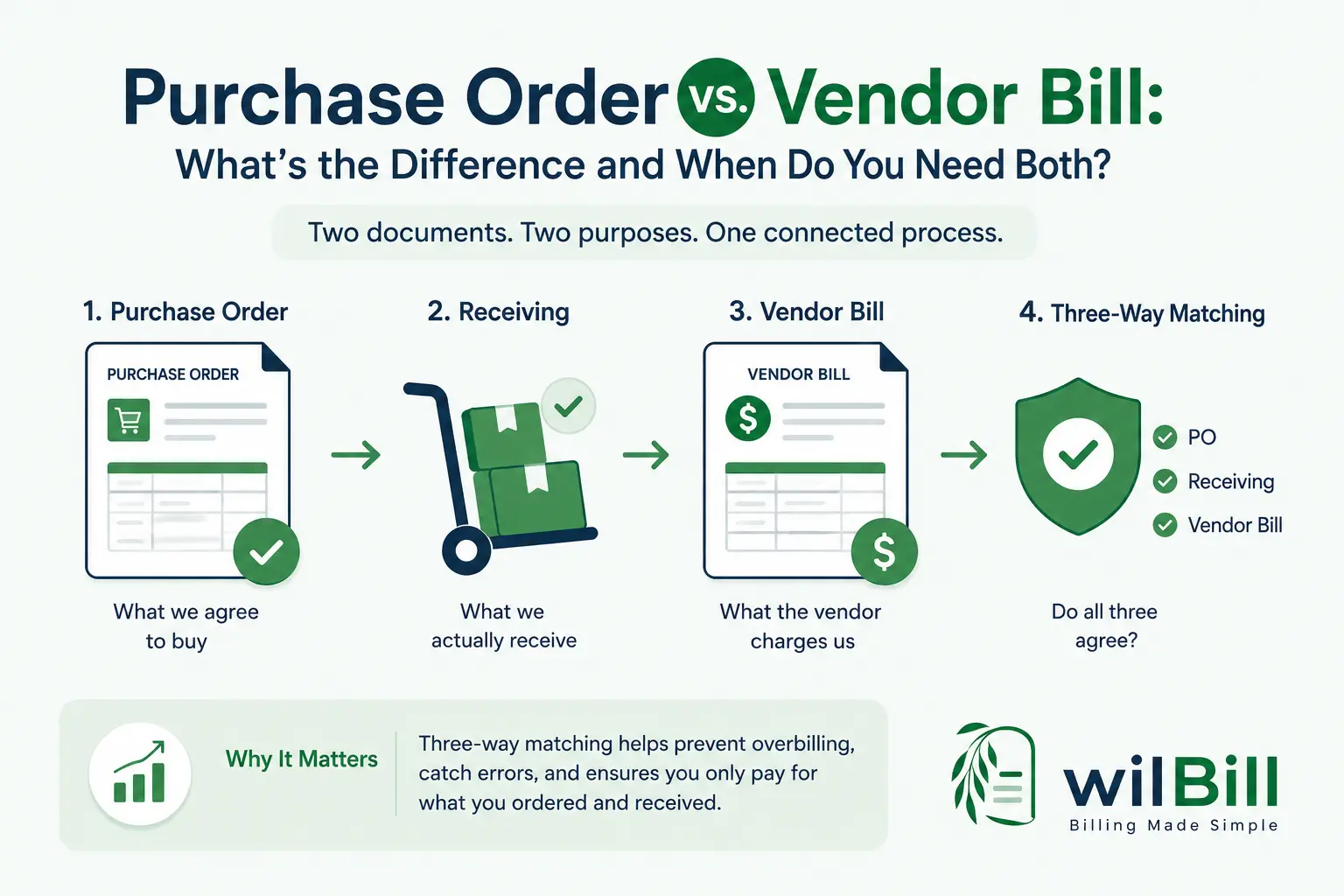
A purchase order (PO) is a buyer-issued document authorizing and recording what a business intends to buy before delivery, whereas a vendor bill is an accounts payable record created from a supplier’s invoice requesting payment for goods or services delivered. A PO sets pre-purchase spending approval and agreed pricing, while a vendor bill creates a formal accounting liability. Businesses connect both through three-way matching-comparing the PO, receiving record, and vendor bill-to verify quantities, catch billing discrepancies, and prevent overpaying.
Key Takeaways
- •A purchase order (PO) is created by the buyer before goods or services are delivered to authorize spend and agree on terms.
- •A vendor bill is an accounting record created after delivery to record the payment liability owed to the supplier.
- •A PO alone does not create an accounts-payable liability; the liability arises when the vendor bill is received and entered.
- •Three-way matching compares the purchase order, receiving record, and vendor bill to catch discrepancies before paying.
- •Connecting POs to vendor bills prevents duplicate data entry, tracks partial deliveries, and maintains a reliable audit trail.
A purchase order and a vendor bill may look similar on paper. Both can contain line items, quantities, agreed prices, and a supplier name. But they represent two very different stages of a purchasing process.
A purchase order (PO) records what your business intends and is authorized to buy. A vendor bill records what a supplier is charging you for goods or services provided.
That distinction matters.
If your business relies only on vendor bills, you may have no reliable record of what was approved before an order was placed. If you treat the PO as the final word and skip checking what was actually delivered, you can end up paying for quantities you never received.
This article explains the difference between purchase orders and vendor bills, when you need both, how they work together, and how three-way matching helps prevent billing errors and overpayments.
Purchase Order vs. Vendor Bill at a Glance
The simplest way to understand the difference is:
“A purchase order says, ‘This is what we agreed to buy.’ A vendor bill says, ‘This is what we owe for what was provided.’”
| Aspect | Purchase Order (PO) | Vendor Bill |
|---|---|---|
| Issued by | Buyer | Vendor / Supplier |
| Created when | Before goods or services are delivered | After goods or services are provided |
| Purpose | Authorize and formalize a purchase | Request payment for goods or services |
| Records | What the buyer intends to purchase | What the vendor is charging |
| Payment obligation | Generally does not record an accounts-payable liability | Records an amount owed when entered into accounting |
| Typical contents | Items, quantities, agreed prices, delivery terms | Items or services, quantities billed, prices, taxes, payment terms, due date |
| Based on | Planned / approved purchase | Goods or services actually provided |
| Created by | Procurement, operations, purchasing, or authorized employee | Supplier / vendor |
| Next step | Receive goods/services and reconcile | Approve and pay |
| Can exist without the other? | Yes | Yes |
The two documents are related, but they are not interchangeable.
What Is a Purchase Order?
A purchase order (PO) is a document a buyer creates and sends to a vendor to formally request goods or services.
A standard PO specifies:
The PO creates a documented record of what the business intends and is authorized to purchase before the order is fulfilled. Total order commitment: $2,150.
Why Purchase Orders Matter
A PO provides an internal checkpoint before money is committed. Without a PO, someone might place an order based on an email conversation, a phone call, a verbal agreement, an outdated price list, or a supplier's previous pricing.
- Who authorized and approved this purchase?
- What unit price and discounts were agreed?
- How many units were ordered?
- When and where was the shipment supposed to arrive?
- Is this purchase still outstanding or partially fulfilled?
Does a Purchase Order Create a Payment Obligation?
A purchase order generally does not record an accounts-payable liability in your accounting ledger. The liability is normally recorded when the business receives and records the vendor's invoice or bill.
However, an accepted PO may create contractual obligations depending on the PO's terms, vendor acceptance, and applicable law. Think of a PO as an approved purchasing commitment and order record, rather than an accounting record of money already owed.
What Is a Vendor Bill?
A vendor bill is the buyer's internal accounting record of an invoice received from a supplier for goods or services. The supplier may call the document an Invoice, Supplier Invoice, or Bill. From the buyer's perspective, it is recorded in Accounts Payable as a vendor bill.
The Key Difference: 4 Core Questions
Purchase Order vs. Vendor Bill: The 5 Core Differences
The biggest differences come down to who creates the document, when it is created, and what it represents in your business workflow.
A purchase order is created by the buyer. A vendor bill is created from an invoice issued by the vendor and recorded by the buyer.
A PO is normally created before goods or services are delivered. A vendor bill is normally received after goods or services have been provided.
A PO authorizes and documents a purchase. A vendor bill requests payment for the goods or services provided.
A PO represents the buyer's planned and approved commitment. A vendor bill represents an amount owed once accepted and recorded in Accounts Payable.
After a PO is issued, the buyer expects delivery or service completion. After a vendor bill is received, the buyer verifies it against the PO and receiving record, resolves any discrepancies, approves it, and processes payment.
When Do You Actually Need a Purchase Order?
Not every purchase requires a PO. Creating a formal purchase order for a one-time $40 office supply purchase may create more administrative work than value. POs become essential as purchasing becomes larger, more frequent, or more distributed across your team.
1. Recurring Purchases From the Same Vendor
If your business buys materials or services regularly, a PO provides a documented record of agreed pricing and quantities. For example, a contractor buying construction materials weekly can track what was ordered, the agreed price, how much has been delivered, and what remains outstanding.
2. Purchases Requiring Internal Approval
If team members need sign-off before spending company funds, a PO provides a formal control point. The process becomes Request → Approval → Purchase Order → Delivery → Vendor Bill → Payment, preventing surprise unapproved invoices.
3. Purchases Tied to Physical Inventory & Materials
Suppose you order 500 units of a product but receive only 450. The PO gives you the original expected quantity. The receiving record captures what actually arrived. Without the PO, identifying that 50 units remain backordered is much harder.
4. Purchases Above a Defined Spending Threshold
Many businesses enforce rules such as “Purchases over $500 require a PO” or “Any inventory restock requires a PO.” A simple threshold establishes clear financial control without bogging down small purchases.
5. Businesses With Multiple People Making Purchases
As the number of buyers in your company grows, relying on memory, scattered emails, and spreadsheets breaks down. A PO creates a shared record that procurement, operations, accounting, and management can all reference.
When Don't You Need a Purchase Order?
A PO may be unnecessary for:
The goal isn't to create a PO for every single paperclip-it is to use POs where the control and visibility outweigh the extra step.
When Should You Use Both a Purchase Order and a Vendor Bill?
You should consider using both when you need to control spending before a purchase and verify the vendor's charges afterward.
10 Scenarios Where Using Both Is Essential:
How a Purchase Order Becomes a Vendor Bill: The 5 Steps
The buyer creates an approved PO detailing line items, quantities, agreed prices, and delivery terms. “This is what we agreed to buy.”
The vendor fulfills the order. The delivery may be complete, partial, split across multiple shipments, delayed, or substituted.
The receiving team counts and records what actually arrived at the warehouse or job site (e.g. PO: 100 units; Received: 80 units).
The vendor sends an invoice for the goods delivered. The bill reflects 80 units rather than 100 if they only billed for the delivered portion.
The buyer compares the vendor bill against the PO and receiving slip. When all match, the bill is scheduled for payment; any discrepancy is investigated.
Real-World Example: PO vs. Receiving vs. Vendor Bill
Consider a general contractor ordering construction materials for a client project. Notice how quantities and amounts evolve through each stage of fulfillment:
| Item | Qty | Price |
|---|---|---|
| Cement | 100 | $10 |
| Steel rods | 50 | $15 |
| Sand | 200 | $2 |
| Item | Ordered | Received |
|---|---|---|
| Cement | 100 | 80 |
| Steel rods | 50 | 50 |
| Sand | 200 | 180 |
| Item | Billed | Price |
|---|---|---|
| Cement | 80 | $10 |
| Steel rods | 50 | $15 |
| Sand | 180 | $2 |
The vendor bill reflects what was actually delivered ($1,910), not the full PO amount ($2,150). This isn't an error. The PO keeps the remaining $240 outstanding in the system for when backordered items arrive, while the AP team safely pays only for verified deliveries today.
What Is Three-Way Matching and How Does It Work?
Three-way matching is the internal control verification process of comparing three documents before approving a vendor bill for payment:
PO vs. Receiving Quantities
If the PO specified 100 units but the warehouse receipt logged 80, the system recognizes that 20 units remain unfulfilled.
Vendor Bill vs. Receiving Quantities
If only 80 units arrived but the vendor invoice bills for 100, the bill is flagged for investigation before any payment is disbursed.
Billed Price vs. Agreed PO Price
If the PO locked in $10/unit but the vendor bill states $12/unit, AP flags the unauthorized $2 price increase for manager sign-off.
What Happens When Documents Don't Match?
A mismatch isn't automatically an error or fraud. Legitimate reasons for variances include partial shipments, backordered inventory, approved substitutions, freight adjustments, taxes, and agreed volume discounts. The critical rule is that every difference is understood and approved rather than silently paid.
7 Common Mistakes in Managing POs and Vendor Bills
A PO records what was ordered, not what actually arrived. Always reconcile the bill against the physical receiving record.
Manually re-typing PO data into a bill introduces pricing and quantity errors. Use a billing platform that converts POs directly into vendor bills with a single click.
If you order 500 units but receive 300, entering the bill as 500 makes your inventory and cash records inaccurate. Keep outstanding quantities tracked.
POs must not disappear after creation. Track statuses cleanly: Open, Partially Received, Fully Received, Billed, Closed, or Cancelled.
A supplier bill may look reasonable on its own. Comparing it against the PO reveals unexpected price hikes, unauthorized items, or altered terms.
If anyone can change an approved PO without an audit trail, pre-purchase approval loses its value. Re-approval should be required for major modifications.
Not all mismatches mean supplier error. Taxes, freight adjustments, authorized substitutions, and partial shipments create legitimate differences. The goal of matching is to ensure every variance has a documented justification.
Purchase Order vs. Invoice vs. Vendor Bill: The Perspectives
These terms are often used interchangeably, causing confusion. Here is the clear breakdown based on perspective:
Authorizes and requests the purchase
Requests payment for delivered goods/services
Accounts payable liability in the ledger
“The purchase order is about the purchase. The vendor bill is about the payment.”
Frequently Asked Questions
Do I need a purchase order for every purchase?
No. POs are most useful for larger purchases, recurring suppliers, inventory purchases, expenses requiring internal approval, or when multiple employees can spend company money. Small, low-value one-off purchases rarely justify the administrative step.
Can a vendor bill exist without a purchase order?
Yes. Many businesses receive vendor bills without creating a PO first, especially for utility bills, subscriptions, professional legal services, and emergency maintenance. The tradeoff is losing the pre-purchase pricing lock and formal approval record.
Can I convert a purchase order into a vendor bill?
Yes, modern accounting software like WilBill allows one-click PO-to-bill conversion. Approved line items, pricing, and vendor details carry forward automatically, after which you adjust quantities to reflect actual receipt.
What happens if the vendor bill doesn't match the purchase order?
The discrepancy should be investigated before payment is made. Determine if the variance is a legitimate adjustment (partial shipment, approved substitution, shipping freight) or a billing error requiring an updated vendor invoice.
Should the vendor bill match the purchase order exactly?
Not always. In partial delivery scenarios, the vendor will bill only for what arrived (e.g. 80 units of an original 100-unit PO). What matters is that the difference is documented, legitimate, and approved.
Is a purchase order legally binding?
An accepted PO may form a binding commercial agreement depending on its specific terms, vendor acceptance, master service agreements, and jurisdiction. Consult qualified legal counsel for high-value contract terms.
What's the difference between a vendor bill and an invoice?
They describe the exact same underlying commercial transaction from opposite sides. The seller issues an invoice; the buyer receives and records it as a vendor bill.
What is three-way matching?
Three-way matching compares the purchase order, receiving record, and vendor bill before payment is authorized. It confirms that the business ordered the goods, received them in good order, and is being billed at agreed rates.
Is three-way matching necessary for a small business?
For solopreneurs with minimal purchasing, manual review is often enough. But for any business managing inventory, job materials, subcontractors, or multiple vendor relationships, three-way matching provides essential defense against overbilling.
Final Takeaway: A Connected Purchasing Workflow
Purchase orders and vendor bills serve different purposes, but they work best together. A purchase order establishes what your business intends and is authorized to buy. A receiving record establishes what physically arrived. A vendor bill records what the supplier is charging. Three-way matching connects all three before money leaves your account.
For businesses with growing purchasing volume, multiple team buyers, inventory, or recurring trade vendors, that visibility prevents duplicate purchases, catches billing discrepancies, and establishes an airtight audit trail.
Suggested Internal Resources
Learn how to create, approve, and track purchase order commitments.
Record, manage, and approve supplier bills with clean payment scheduling.
Manage supplier directories, purchasing history, and outstanding balances.
Turn approved POs into vendor bills instantly without re-entering line items.
Compare purchase orders, receiving records, and vendor bills to prevent overpayment.
Ready to Streamline Billing & Purchasing?
WilBill connects purchase orders, vendor bills, inventory tracking, and client invoicing in one seamless workspace.
Related Guides
Reorder Points: How to Prevent Stockouts Without Overstocking
Learn the reorder point formula, calculate safety stock, account for lead time and demand changes, and prevent stockouts without overstocking.
Vendor Management Best Practices: Building a Reliable Supplier Base as You Scale
Learn practical vendor management strategies for small businesses, from onboarding and performance reviews to payment terms, risk, and supplier diversification.