
Vendor Management Best Practices: Building a Reliable Supplier Base as You Scale
Learn practical vendor management strategies for small businesses, from onboarding and performance reviews to payment terms, risk, and supplier diversification.
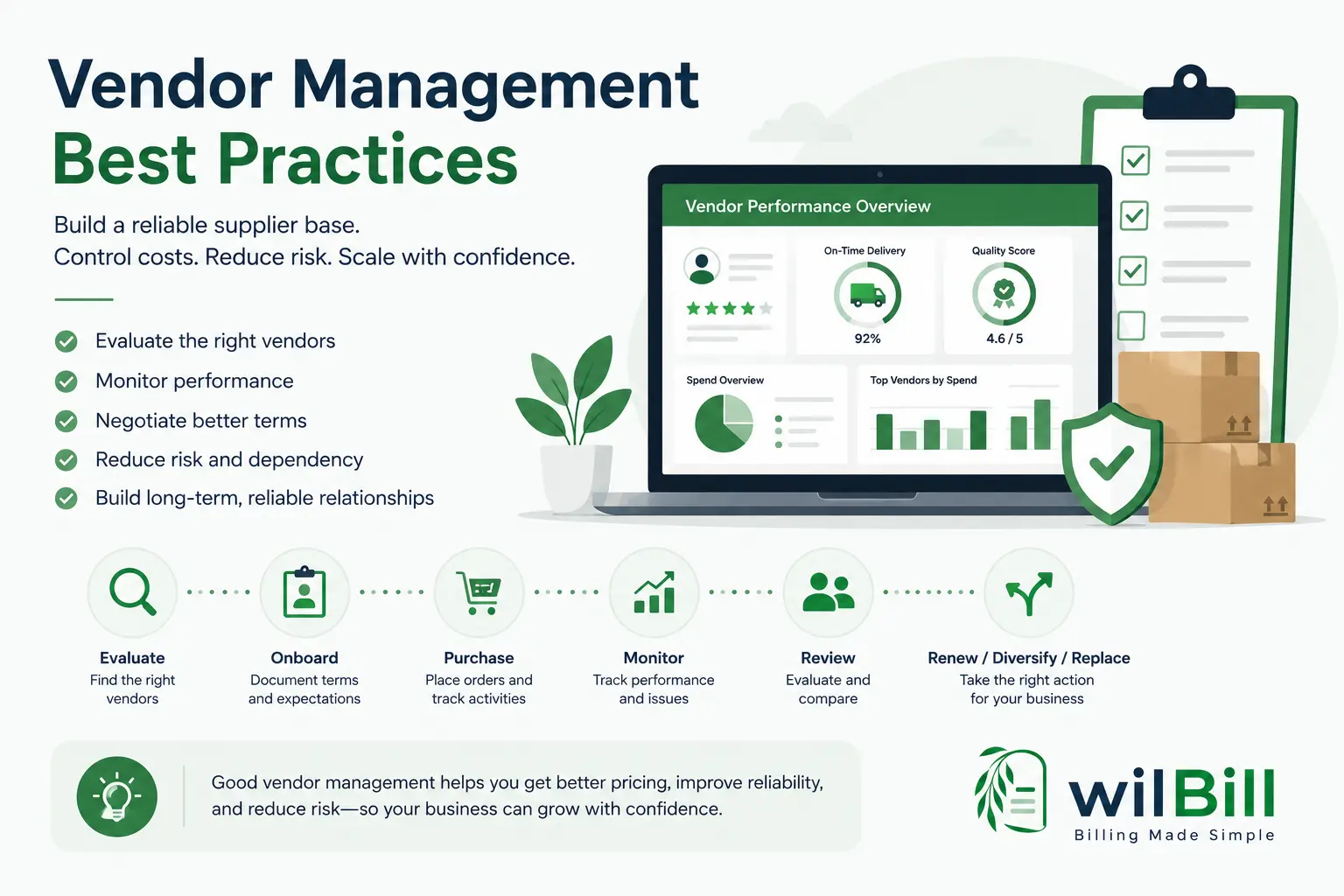
Vendor management is the continuous process of evaluating, onboarding, purchasing from, monitoring, reviewing, and renegotiating supplier relationships to control costs, maintain delivery reliability, and mitigate operational risk. Small businesses build an effective vendor management system by centralizing vendor files (pricing, payment terms, contracts), tracking five core performance metrics (on-time delivery, order accuracy, quality, price stability, responsiveness), classifying suppliers by risk tier, maintaining qualified backup suppliers for single-source dependencies, and conducting structured quarterly reviews.
Key Takeaways
- •Vendor management follows a continuous lifecycle: Evaluate → Onboard → Purchase → Monitor → Review → Renew/Replace.
- •Informal vendor tracking leads to unmonitored price creep, hidden delivery delays, and dangerous single-source supplier dependency.
- •Track essential vendor information centrally: agreed unit pricing, payment terms (Net 15/30), lead times, and renewal dates.
- •Evaluate performance on five core metrics: on-time delivery, order accuracy, defect rate, price stability, and response velocity.
- •Consolidate low-risk purchases to maximize volume discounts, but diversify critical supplies to guarantee business continuity.
Most small businesses start with vendor relationships that happen informally. A supplier gets added because someone needed materials quickly, a freelancer gets hired because they were available, or a service provider sticks around because switching felt like more trouble than it was worth.
That approach works when you have three or four vendors.
It becomes harder to manage when you have ten, twenty, or more suppliers and nobody can remember which vendor missed a delivery last quarter, which one quietly increased prices, or which supplier has become too important to replace easily.
Vendor management is the process of selecting, onboarding, monitoring, evaluating, and maintaining supplier relationships so your business can control costs, maintain reliability, and reduce operational risk.
It isn't about adding bureaucracy for its own sake. It's about having enough structure to catch problems-cost creep, unreliable deliveries, quality issues, and supplier concentration-before they become expensive.
This guide explains practical vendor management best practices for small businesses, without requiring an enterprise procurement department.
Why Informal Vendor Management Breaks Down
A handful of vendors can often be managed from memory. As the business grows, that informal approach stops working for five predictable reasons:
Without a record of what was originally agreed, small price increases go unnoticed. A supplier might increase prices by a few percent at a time. Over hundreds of orders, subtle cost creep creates a substantial financial drain.
A vendor delivering late three times in six months seems manageable if handled in isolation. Tracking delivery performance reveals systemic patterns, separating isolated delays from a supplier with an unacceptable 70% fulfillment rate.
A supplier representing only 10% of total spend can still represent critical single-source operational risk if they supply a specialized, hard-to-replace component or essential service.
When pricing, contacts, agreements, and history live solely in personal inboxes, the company is vulnerable when key staff change roles. Centralized vendor records create lasting institutional memory.
5. Payment and Contract Terms Get Forgotten
Businesses regularly lose track of contractual payment terms (Net 15 vs Net 30), early payment cash discounts, renewal dates, Minimum Order Quantities (MOQ), return policies, warranties, and delivery lead commitments without a single source of truth.
What Information Should You Track for Each Vendor?
A useful vendor record should contain far more than a basic name and phone number. The goal is enough documentation so that price disputes, late shipments, or renewal decisions never require digging through old emails.
Essential Vendor Data
Enhanced Due Diligence
Match diligence to risk: an office stationery supplier requires minimal vetting, while a critical production vendor requires formal compliance records.
How to Onboard a New Vendor
A standardized 5-step onboarding process prevents costly misunderstandings before the first commercial purchase order is issued.
Confirm Pricing and Terms in Writing
Document agreed unit prices, payment terms, delivery expectations, minimum order quantities, and freight terms in writing. Never wait until the first invoice arrives to discover pricing discrepancies.
Verify the Vendor
Check business registration, references, quality certifications, insurance policies, return rules, and warranty terms. Align due diligence with financial exposure.
Test Actual Lead Times
Don't rely solely on quoted promises. Use the initial order to measure actual transit and fulfillment velocity. Record the results so future operational schedules reflect reality.
Document the Relationship Immediately
Log contract terms, tax identifiers, contacts, and discount structures into your central software while details are fresh, ensuring institutional memory remains intact.
Schedule an Initial 90-Day Review
Evaluate: Did they deliver on schedule? Did billing match agreed quotes? Was defect rate acceptable? Were queries resolved swiftly? A vendor onboarded once and never reviewed will quietly drift on cost and quality.
How to Evaluate Vendor Performance
Small businesses don't need complex enterprise scorecards. A streamlined review tracking five core operational metrics provides clear supplier visibility:
| Metric | What to Track |
|---|---|
| On-Time Delivery | Percentage of orders delivered within the agreed contractual lead time |
| Order Accuracy | Percentage of orders delivered with exact line-item quantities and specifications |
| Quality & Defect Rate | Percentage of orders received without defects, shipping damage, or substandard work |
| Price Stability | Frequency of unexpected or unapproved price hikes versus agreed quotes |
| Issue Responsiveness | How quickly billing disputes, returns, or support inquiries are acknowledged and resolved |
How Often Should You Review Vendor Performance?
You don't need to review every vendor at the same cadence. Divide suppliers into three clear risk tiers:
Quarterly Reviews
For suppliers with significant spend, critical materials, limited marketplace substitutes, or contracts approaching renewal.
Semi-Annual Reviews
For regular operational vendors where viable alternatives exist, reviewing performance twice a year maintains cost and quality alignment.
Annual / As Needed
For low-value, easily replaceable purchases with minimal operational exposure, review annually or only when an explicit issue occurs.
How to Manage Vendor Risk & Concentration
Vendor risk is the possibility that a supplier's failure, substandard quality, or financial insolvency disrupts your business.
Managing Concentration Risk: Single Points of Failure
If one supplier accounts for 60% of your materials, a single plant shutdown or supply disruption threatens your entire operation. Ask: “If this vendor stopped delivering tomorrow, could our business operate normally?”
How to Negotiate Vendor Payment Terms
Payment terms are often far more flexible than small business owners assume. Approach negotiations collaboratively:
Extend Terms with Volume
As purchasing volume grows and your payment track record proves reliable, request extended terms (e.g., Net 45 or Net 60) to protect working capital.
Early-Payment Cash Discounts
Many suppliers offer 1–2% discounts for payments made within 10 days (e.g., 2/10 Net 30). Calculate annual savings against your cash flow before opting in.
Renegotiate at Review Milestones
Annual contract reviews and volume threshold crossings are natural, non-adversarial moments to optimize terms.
Consolidation vs. Diversification: Which Is Better?
There is no single strategy for every category. Consolidate where purchasing efficiency matters; diversify where business continuity matters.
| Operational Situation | Recommended Sourcing Approach |
|---|---|
| Standard, low-risk, easily replaceable purchases | Consolidate for volume pricing |
| Critical materials with few marketplace alternatives | Diversify across vetted suppliers |
| Reliable vendor offering significant tier discounts | Consolidate to maximize margin |
| Supplier exhibiting recurring delivery or quality issues | Diversify and transition spend |
| Vendor is a major single-source dependency | Maintain an active qualified backup |
| Switching providers is technically difficult | Develop secondary contingency option |
When and How to Offboard a Vendor
End relationships based on persistent negative patterns rather than isolated blunders. When replacing a vendor, follow this orderly offboarding process:
Structured Offboarding Workflow:
Documenting the rationale prevents future staff from mistakenly re-engaging problematic suppliers.
Vendor Management Checklist for Small Businesses
Frequently Asked Questions
How many vendors should a small business track closely?
Focus close tracking on the 20% of vendors representing 80% of spending or your highest operational dependencies. A vendor used once a year for office snacks does not require the same governance as your primary material supplier.
What's the difference between vendor management and procurement?
Procurement refers specifically to sourcing and purchasing goods. Vendor management is the broader lifecycle, including ongoing relationship health, performance auditing, risk management, term renegotiation, and offboarding.
What are the most important vendor management metrics?
On-time delivery, order accuracy, defect rate, price change frequency, and dispute resolution time. Tracking these five gives an immediate view of supplier quality.
How often should vendor pricing be reviewed?
Review recurring pricing at least annually and immediately whenever a vendor bill deviates from the agreed purchase order quote.
Is it worth using multiple vendors for the same item?
For critical materials with high operational impact, maintaining at least one qualified backup protects against supply disruptions. For routine, low-risk items, consolidating with a single vendor is more cost-effective.
What is a vendor management system?
A vendor management system is software that centralizes supplier directories, purchase orders, vendor bills, performance history, and contracts into a unified workspace.
How do you rank vendors?
Score vendors 1–5 on delivery speed, accuracy, quality, and responsiveness. Use these scores during quarterly reviews to determine renewals, contract expansions, or replacements.
Final Takeaway: Scale With Reliable Suppliers
Good vendor management isn't about managing every supplier with the same heavy bureaucracy. It's about knowing which vendors matter most, what you've agreed to, how they're performing, and where your business is exposed to risk.
Start by creating a reliable vendor record with agreed pricing, payment terms, contacts, and order history. Use purchase orders and three-way matching to catch billing errors before payment, enforce structured expense approval workflows, and review key suppliers quarterly.
Manage Vendors With Better Visibility
A basic contact list isn't enough as your supplier relationships grow. Keep vendor profiles, agreed pricing, payment terms, purchase orders, and vendor bills organized in one seamless workspace.
Ready to Streamline Billing & Purchasing?
WilBill connects purchase orders, vendor bills, inventory tracking, and client invoicing in one seamless workspace.
Related Guides
Reorder Points: How to Prevent Stockouts Without Overstocking
Learn the reorder point formula, calculate safety stock, account for lead time and demand changes, and prevent stockouts without overstocking.
Purchase Order vs. Vendor Bill: What's the Difference and When Do You Need Both?
Purchase orders and vendor bills serve different purposes. Learn when to use each, how they connect, and how three-way matching prevents overpayment.