
How to Reduce Days Sales Outstanding (DSO) for Service Businesses
Learn how to calculate DSO, identify a healthy benchmark, and use practical fixes to speed up client payments and improve cash flow.
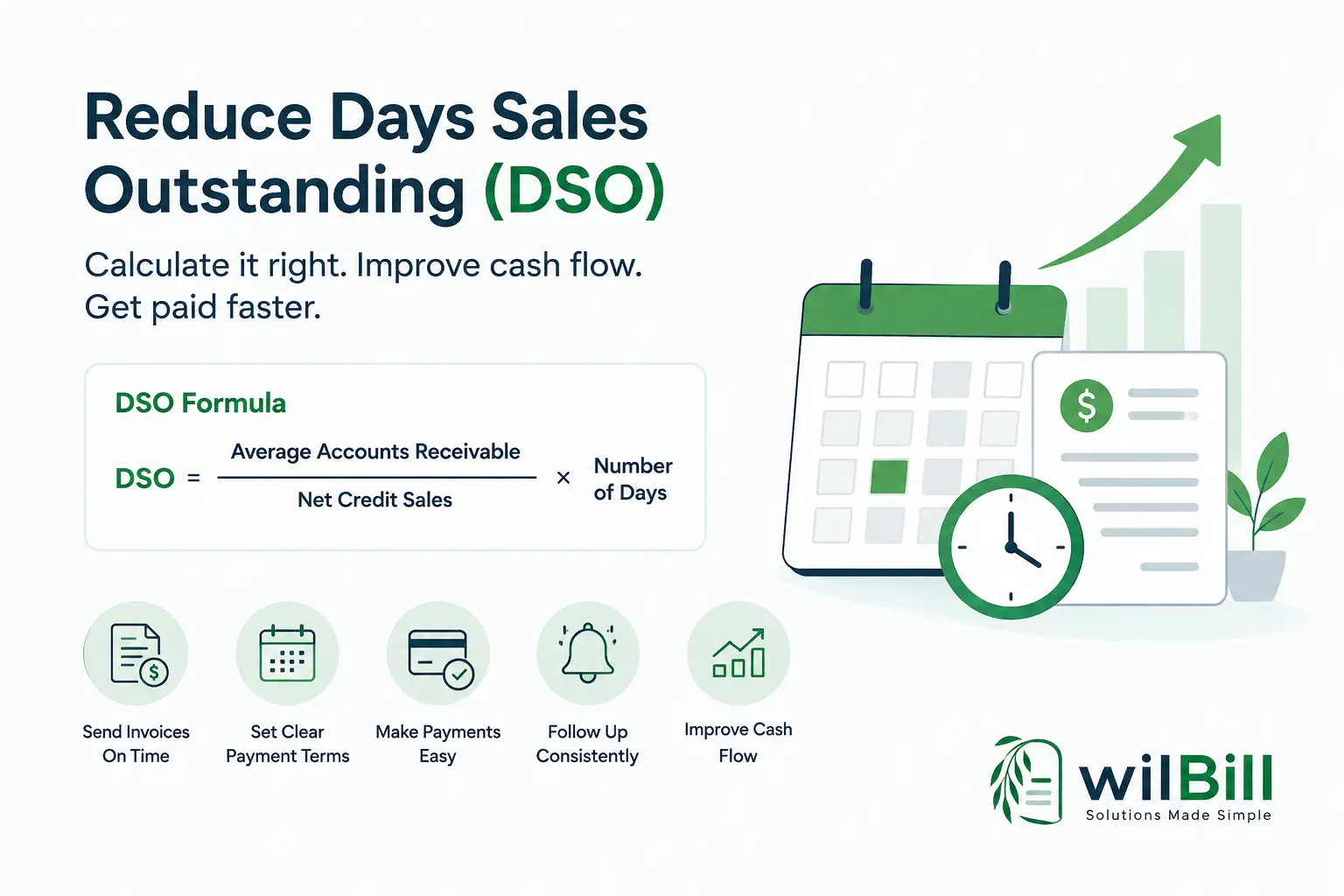
Days Sales Outstanding (DSO) is the average number of days it takes a business to collect payment from credit sales, calculated as (Average Accounts Receivable ÷ Net Credit Sales) × Days in Period. Service businesses can reduce DSO by invoicing immediately upon milestone completion, offering frictionless online payment options, automating recurring retainer invoices, following up on a consistent reminder cadence, and tracking collection velocity per client.
Key Takeaways
- •DSO measures how long cash is tied up in accounts receivable after a credit sale is made.
- •Standard Formula: (Average Accounts Receivable ÷ Net Credit Sales) × Number of Days in Period.
- •Benchmark DSO against your agreed contractual payment terms (e.g. Net 30 should aim for 30–45 days).
- •Reduce DSO by billing promptly, eliminating payment friction, automating recurring invoices, and tracking client-specific payment behavior.
- •Combine DSO with an AR aging report to identify both broad collection trends and specific overdue accounts.
Days Sales Outstanding (DSO) measures how long it takes, on average, for a business to collect payment after making a credit sale. A high DSO doesn't necessarily mean your business is unprofitable. It means more of the cash you've earned is tied up in accounts receivable instead of being available to pay employees, suppliers, taxes, and operating expenses.
For agencies, consultants, contractors, and other service businesses, DSO can be an especially useful cash-flow indicator. Revenue can continue growing while unpaid invoices grow even faster, creating a cash squeeze that isn't immediately obvious from the income statement.
The good news is that DSO is usually something you can improve through better billing processes, clearer payment terms, easier payment options, and consistent collections.
This guide explains how to calculate DSO, how to interpret it relative to your payment terms, why it increases, and the practical steps you can take to reduce it.
What Is DSO and Why Does It Matter?
Days Sales Outstanding (DSO) is the average number of days it takes a business to collect payment from credit sales.
It is a direct measure of how efficiently a business converts revenue earned on credit into cash in the bank.
The Real-World Cash Impact
Imagine a service business generating approximately $50,000 in monthly net credit sales with a DSO of 45 days.
That means approximately $75,000 is sitting in unpaid client invoices instead of being available as working capital.
What Healthy Sales Look Like
- Strong monthly revenue
- Healthy gross margins
- Profitable client contracts
- Growing pipeline
The Hidden DSO Squeeze
Despite high profitability, you can still face working capital and payroll stress when cash is locked up in uncollected client receivables.
Why DSO Matters Specifically for Service Businesses
Service businesses have a particular cash-flow challenge: the work and expenses happen upfront before payment. An agency pays employees and contractors today, delivers a project this month, sends an invoice afterward, and waits another 30, 45, or 60 days for payment.
There is no physical inventory to liquidate. Once delivered, the outstanding invoice is the primary asset waiting to convert into cash.
How to Calculate DSO
Monthly DSO Walkthrough
Result: The business takes roughly 19.5 days on average to turn credit sales into cash.
Simpler Operational Formula for Quick Checks
Simplified DSO = (Ending Accounts Receivable ÷ Net Credit Sales) × Days in Period
Use this for daily or weekly monitoring. For monthly financial reviews, stick with Average AR to smooth out billing spikes.
What Should Be Included in the DSO Calculation?
Use Net Credit Sales
Exclude cash paid upfront. If you did $60k total ($10k upfront + $50k on invoice terms), use $50k net credit sales in the equation.
Use Average AR
Ending AR alone can be skewed if a huge invoice was sent on the 30th. Taking (Beginning + Ending) ÷ 2 provides accurate representation.
Consistent Period
Monthly is ideal for most service companies. If revenue fluctuates wildly with quarterly retainers, use a rolling 90-day window.
What's a Good DSO for a Service Business?
There is no universal "good" DSO. The most accurate benchmark is your DSO relative to your contractual payment terms.
| Contract Terms | Target DSO Range | Review Required |
|---|---|---|
| Net 15 | 15–25 days | 35+ days |
| Net 30 | 30–45 days | 60+ days |
| Net 60 | 60–75 days | 90+ days |
If your average DSO is 52 days and your contractual terms are Net 30, your DSO Gap is 22 days. That gives you an exact measure of collection drag.
Why DSO Creeps Up Even When Clients Aren't the Problem
Businesses often blame slow payments on clients. While that can be true, many delays originate in internal billing workflows.
Invoices Go Out Late
Finishing a project on the 1st but waiting until the 7th to bill adds 6 days of unbilled delay before the client clock even starts.
Unenforced Payment Terms
Net 30 printed on a PDF does not collect itself. Without clear onboarding and reminders, clients prioritize bills that follow up.
Payment Friction
Forcing clients into manual bank wires, paper checks, or buried instructions adds friction that postpones payment execution.
Inconsistent Follow-Up
Ad-hoc reminders sent only when someone remembers to check bank balances produce erratic and extended payment cycles.
Invoice Disputes
Vague line items, confusing expense markups, or missing milestone details freeze client approval workflows until clarified.
Reaching the Wrong Person
Sending invoices only to project leads rather than dedicated AP departments leaves invoices stalled in inboxes for weeks.
7 Practical Ways to Reduce DSO
Invoice as Soon as Allowed
Don't wait until month-end batch runs. Send invoices the instant work is delivered or milestone approval is reached.
Shorten Payment Terms Where Appropriate
Net 30 isn't mandatory. For new clients, smaller projects, or standard service deliverables, implement Net 15 or 50% upfront milestone billing.
Make Payment as Frictionless as Possible
Online payment links with card, bank transfer, and mobile wallet options allow clients to approve and pay in 60 seconds without manual wire setup.
Automate Recurring Invoices
For monthly retainers, automated invoice generation and automated email delivery eliminate human memory gaps and resend delays.
Build a Consistent Reminder Cadence
Send friendly reminders 3 days before due date, first overdue notice at +3 days, firm follow-up at +14 days, and phone escalation at +30 days.
Consider Early-Payment Incentives
A 2% discount for payment within 10 days (2/10 Net 30) motivates enterprise AP departments to fast-track your invoices in their payment queue.
Track DSO by Client
Company-wide DSO masks outliers. If overall DSO is 38 days but your largest client averages 70 days on $100k, they are the source of your cash squeeze.
How Much Cash Is Tied Up in Receivables?
Rule of thumb formula for service businesses: Cash Tied Up ≈ Monthly Net Credit Sales ÷ 30 × DSO
Reducing DSO from 60 days to 20 days injects $66,667 of permanent liquid cash into your business without taking on debt or closing a single additional sale.
DSO vs. an Accounts Receivable Aging Report
Tells You HOW LONG
Provides a single high-level velocity metric representing average collection duration across your entire business.
Tells You WHERE
Segments invoices into aging buckets (Current, 1–30, 31–60, 61–90+ days) to reveal the exact overdue customers.
A Simple 30-Day Plan to Reduce DSO
Measure Baseline
Calculate current DSO, client DSO, and identify your top 5 largest overdue accounts.
Fix Billing Delays
Automate recurring retainers, eliminate post-project delay, verify AP email addresses.
Improve Follow-Up
Roll out scheduled polite email reminders and personally call long-overdue accounts.
Adjust Terms
Introduce Net 15 for new clients, require deposits, and enable 1-click card payments.
Frequently Asked Questions
What is considered a bad DSO?
DSO must be judged relative to your contractual terms. A 55-day DSO is healthy for Net 60 terms, but alarming for Net 15 terms. A Net 30 business with DSO above 60 days should immediately investigate collection bottlenecks.
Does DSO include unbilled work in progress?
No. DSO measures receivables only after an invoice is created. Completed but unbilled work represents additional hidden cash-flow risk because the payment clock has not yet started.
Can DSO be too low?
Generally, low DSO is positive. However, an artificially low DSO might mean your terms are overly restrictive (e.g. 100% upfront only), which could limit deals with larger enterprise customers who mandate standard Net 30 vendor invoicing.
How often should I calculate DSO?
Monthly is best for most small to mid-sized businesses. Weekly calculation is useful if you are in an active cash remediation phase or invoicing high volumes regularly.
What is the fastest way to reduce DSO?
Sending invoices immediately upon job completion, embedding instant online payment buttons, and setting automated polite payment reminders produce the quickest improvements.
Recommended Financial Topics
Eliminating friction to accelerate client collection speed.
Automate recurring client billing schedules with zero manual delay.
Balancing incoming receivables against vendor liabilities.
Ready to Streamline Billing & Purchasing?
WilBill connects purchase orders, vendor bills, inventory tracking, and client invoicing in one seamless workspace.
Related Guides
Expense Approval Workflows: How to Set Spending Limits Without Slowing Your Team Down
Learn how to build an expense approval workflow with spending limits and approval tiers that improve control without slowing your team down.
Purchase Order vs. Vendor Bill: What's the Difference and When Do You Need Both?
Purchase orders and vendor bills serve different purposes. Learn when to use each, how they connect, and how three-way matching prevents overpayment.